PRECIOUS PIXELS
TW: Vulnerability exploitation, pr*dator risks discussed (brief, practical)
WHY I’M CHOOSING PRIVACY FOR MY KID ONLINE
We had our baby!!! Well, my wife did… I was more like: Captain Moral Support… and don’t worry, I did NOT backseat deliver! Success, little is gorgeous and every single magic cliche applies, but those tales are for another time.
In my typical media-whote fashion, the lead-up publicity was a blaze and my internet community was equally ready to pop alongside my wife… then I went radio-silent. Such a tease! They no get to see the precious fruit of my wife’s labour. Why? Big, why? I wrestled hard with this one, but i concluded that I needed to transcend the usual selfie reflex. So here’s the short, blunt, official statement:
My daughter will not be put online in any way, shape, or form until at least puberty, when she can take the digital reins and begin to construct her own online identity.
This post is the cleaned-up, read-aloud version of Waxing Prosaic - Precious Pixels: same voice, organized so you can understand my POV (point of view) and maybe adopt some possibly optimal ways to rear your littles when it comes to the Wild West that is the internet. Key words: “maybe” and “possibly”. I am a socialist in the streets but a libertarian in the sheets: ZERO SHAME in regards to how you choose to internet parent!!! My point of introducing these optimal protocols is to bolster everyone’s informed consent.
I love photos (I’m a filmmaker, so le duh), I am a hopeless romantic when it comes to sentimental family time capsules, and I am also in the midst of formal training to study people as a psychologist: that combination made me obsess about the trade-offs. This wasn’t an easy call BUT below I sketch the reasoning, the practical rules I use (low-friction, they’re actually usable), and the psychological frames that convinced me to hit “private” for my kid… until SHE is ready to hit “public”.
FOR THE RECORD: I consent to this embarrASSing photo of child me being shared online!
WHAT’S AT STAKE
Commonly these days, a simple photo of a child isn’t just a private family memory; it’s potentially for the vast majority of the world to see, copyable, it may even be possible to monetize it… and it could haunt them for life. That matters because kids can’t meaningfully consent:
CONSENT - Voluntary, conscious, and active agreement to engage in an activity.
ASSENT - Affirmative, voluntary agreement of a person who is not legally capable of giving informed consent… therefore, a formality.
With the advent of AI, any inkling of one’s likeness can be effortlessly remixed or weaponized (imagine using deepfakes for nuclear-level bullying). I unpack the shit out of those risks in the episode, but to cut to the chase: I’m erring on the side of a deliberate lag. Instead of a “head start” getting my daughter’s fledgling identity online ASAP, I am choosing to give my daughter a “foot finish”, if you will.
I think I’m clever.
TINY, LITTLE DEVELOPMENTAL PSYCHOLOGY CONTEXT
Theory of Mind (3 to 5 years old) - Cognitive ability to attribute mental states (beliefs, desires, intentions and emotions) to oneself and others.
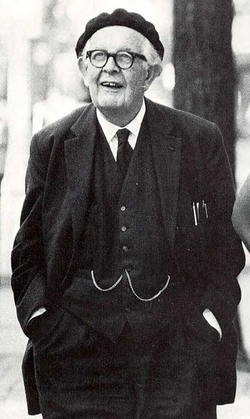
Excellent Style
Jean Piaget - Theory of Genetic Epistemology (cognitive developmental Stages of children)
Concrete Operational Stage (7 to 11 years old) - Children develop logical thinking about physical, real-world events.
Formal Operational Stage (11 to 18 years old) - Marked by the ability to think both abstractly and hypothetically.
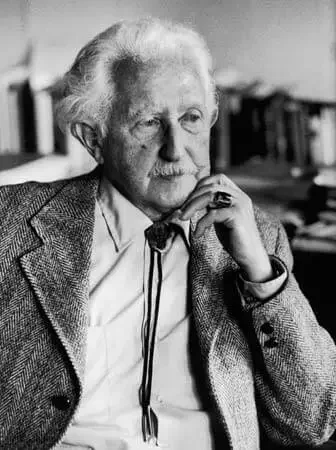
Badass Bolo (good band name)
Erik Erikson - Developed birth-to-grave life stages.
Identity vs Role Confusion (12 to 18) - Adolescents must explore their independence and develop a strong, coherent sense of self, including their values, beliefs and career path.
A SIMPLE (YET IMPORTANT) EXPERIMENT
If your child is 7–12, try this*:
Snap a photo of your child, print it, and take the child to a busy public place.
Explain to the child that you want to post their photo for everyone to see.
Including possible outcomes and ramifications.
The way they react will tell you how much they grasp about public exposure.
If they recoil, listen.
If they say yes, then you’ve engaged in a concrete, age-appropriate conversation.
*If the child gives assent, be ready to counsel them further for possible negative feedback… which likely won’t come because the point of this is to experience real life… only the web can be so cruel!
THE GREY SCALE (not the one you’re thinking of)
I want to go ahead and acknowledge that the sharing of a child’s likeness is, like anything else, subject to loads of nuance. Below are scales that I developed for two of the variables:
FREQUENCY
Zero - No digital footprint
Manicured - polished family photos
Time Capsule - Milestones
Exhibitionist - All of the dang time!
PRIVACY MEASURES
Zero - No digital footprint
Mindful - Closed circuit
Exhibitionist - Everywhere!
These two lists intersect to form a matrix:
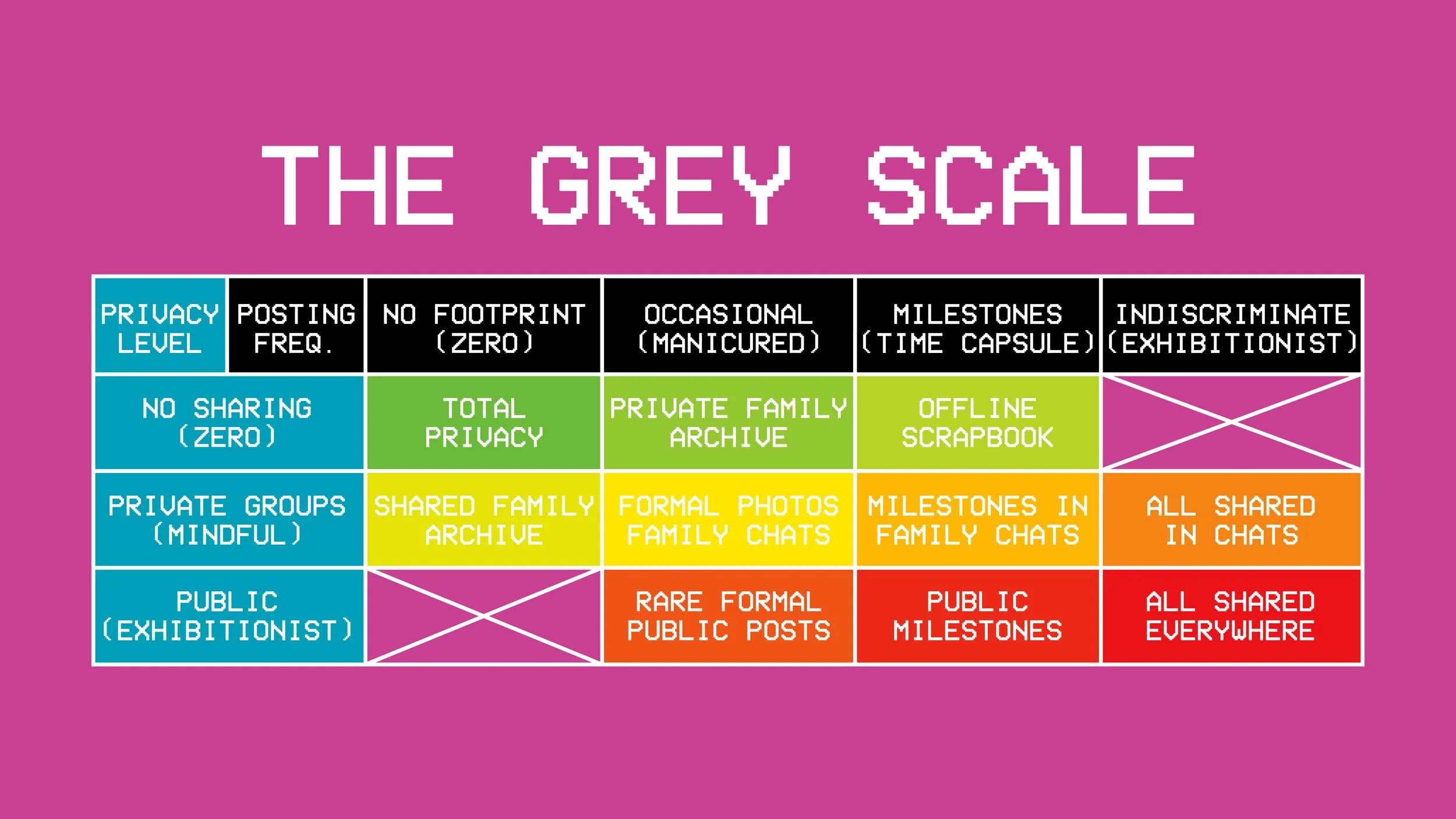
The Grey Scale (OPEN SOURCE!!!)
To all the social scientists out there: this one is open source! Feel free!
“VIRTUE IS A MEAN” - THE RULE I PICKED
I would LOVE to lock down my daughter’s online presence until her prefrontal cortex has completeled it’s connection to her limbic system… but restricting phone access until 25… not going to work (or legal! She’s a damn adult at that point!). FINE! I demand 18! She’s under my roof, my rules! No… that is a recipe for my daughter to resent me AND for her to be rejected from her tribe (her peer group).
So, I landed on: No public posting of my child’s likeness until she reaches puberty and SHE can meaningfully weigh the trade-offs herself. This approach takes the established developmental psychology milestones listed above and mashes them together with the fact that we have ALL GONE THROUGH PUBERTY… We are the most self-conscious we will ever be in our lives.
Interweaving clinically recognized developmental psychology with raw, anecdotal experience and emotions is a recipe for optimal best practices for protecting our youth.
Also: RITES OF PASSAGE… So important.
THE “WHY” BEHIND MY DECISION
A HISTORY LESSON | TECH ONCE PROTECTED US
When photography required a lengthy sit (slow shutters for the win!) and film cost money, photos were precious and shared in very small circles. That scarcity created natural gatekeepers and delayed gratification (good for the brain!). That limitation shaped how we carefully built identity without images of ourselves being shared by ourselves and others.
Today, phones inherently remove the gatekeepers; everything is unlimited, instant gratification and of global spread. That cultural jump matters a whole lot much, because our primitive brains (even more, kids’ brains) evolved for slower, smaller social circles.
THE ROSES | SOME “WHY” PEEPS POST THEIR KIDS
Posting kids connects people, builds community, and can help isolated parents feel seen. For marginalized families it can be advocacy and voice. Posting floods bonding chemistry: oxytocin for the poster and dopamine for the likes… and that’s not inherently bad.
I spent two score posting my embarrassment as “art” for attention; I get the appeal.
Um, and it’s just fun! Who knows… maybe even your kid will hit the lottery by going viral and your whole family will be endlessly rich‽
THE THORNS | REAL PSYCHOLOGICAL RISKS
Consent & Cognitive Development: Young children (0–5) lack theory of mind and cannot grasp what “posting to billions” means. Ages ~7–12 (Concrete Operational) still struggle with abstract consequences; puberty brings “Formal Operational” and better capacity to weigh abstractions and outcomes. That developmental timeline is core to this protocol.
Praise Paradox / Fragile Identity: Early, public, quantifiable praise can become a hedonistic treadmill. Kids chase metrics they’re not developmentally equipped to handle. Praise process and effort offline instead.
Parasocial Shock: Kids who grow up exposed online risk meeting strangers who feel like they “already know” them, which can be a confusing experience for children still forming stable identities.
AI, Deepfakes & Extortion: The near future will make realistic misuse easier (deepfakes, synthetic media, AI models trained on public images). For vulnerable minds, seeing manipulated content of themselves could be deeply damaging. I ain’t rolling no dice on that one.
Predatory Exposure!!!!!!!!: While rare, the internet enables very bad actors to find and misuse images. That’s a grim reality to acknowledge… but acknowledge we must.
POLICY, TECH & THE FUTURE
Governments are starting to notice: Illinois has laws around compensating monetized child creators; France has made it illegal to share someone’s likeness without consent (possible 50,000 Euro fine), and Denmark has made it possible for civilians to copyright their likeness.
Tech may help too, think phone-level “force fields” or AI filters that protect children’s faces in photos… but that’s still noisy future-speak.
For now, parental choices matter more than platform promises. Maybe change ought not come from top to bottom… but bottom to top!
FINAL ASK & PODCAST PROMISE
I’m not shaming any parent who posts their children’s likeness online; I was one of you… I AM one of you!!! I still think about posting my daughter as it would be a gold mine of engagement!!! But upon examination, the juice ain’t worth the clout.
The purpose of this content is to ask for intentionality. Every time you post your kid, ask:
Who benefits? What am I getting? Could this be embarrassing or harmful down the road?
If you keep that small ritual, you’ll be doing far better than the baseline. And hey, if you made it this far and still want to post your child, fill your boots! Just please, ask for assent. Look them in the eye and say, “May I post this?” If they say no, listen.
That habit itself will build a healthier culture of consent.
Fin.